

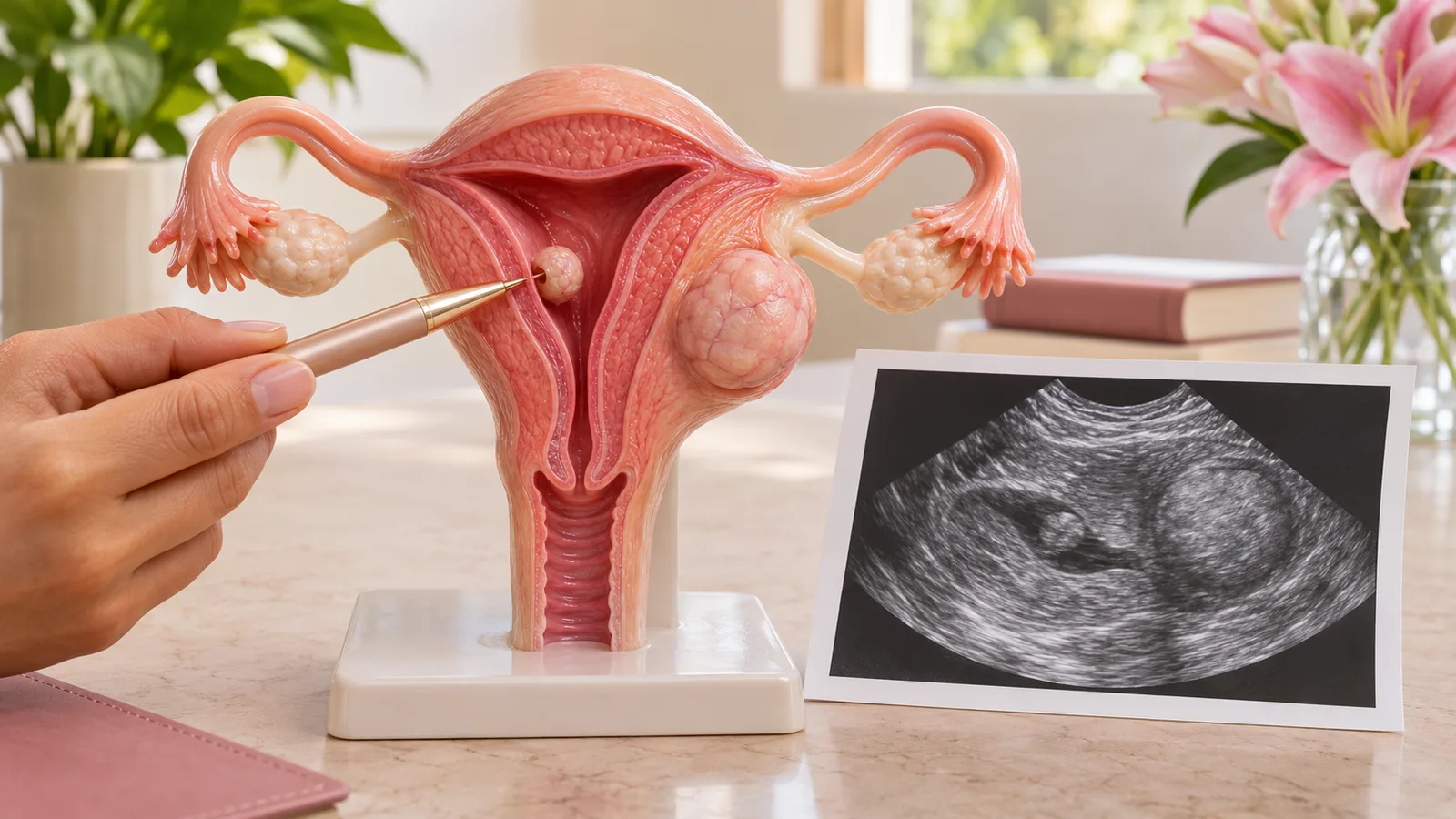
Your ultrasound report says you have a 2 cm fibroid. That sounds small, so you assume it cannot be affecting your chances of getting pregnant.
But your gynecologist wants to know exactly where it is growing.
Why should the position of something so small matter?
When it comes to fibroids and fertility, the answer isn't always in the measurement. A fibroid growing into the space inside the uterus may deserve more attention than a larger one growing towards the outside. Its location can change how doctors assess the possibility of pregnancy, even when it causes few noticeable symptoms.
That doesn't mean a small fibroid will prevent conception. Many women become pregnant with fibroids and never need surgery.
The question is whether that particular fibroid is affecting the uterine cavity, where an embryo would normally implant.
For women planning pregnancy, Dr Vinita Khemani's website explains how fertility evaluation and individualised management can help identify possible factors affecting conception before treatment decisions are made.
Can Fibroids Affect Fertility and Make It Harder to Get Pregnant?
Yes, some uterine fibroids can make conception more difficult, particularly when they grow into or change the shape of the uterine cavity. Fibroids that remain outside this space often have less direct influence on implantation, although their size, number and position still matter.
Doctors generally describe fibroids according to where they grow:
- Submucosal fibroids: Grow towards or into the space inside the uterus.
- Intramural fibroids: Develop within the muscular wall of the uterus.
- Subserosal fibroids: Grow towards the outer surface of the uterus.
Two women may have fibroids of almost identical size, yet the findings could lead to completely different recommendations.
The reason is that the fibroid's relationship to the uterine cavity can be more informative than its diameter alone.
Why the Location of a Fibroid Matters
Think of the uterus as having a central space surrounded by a muscular wall.
That inner space is called the uterine cavity. During the menstrual cycle, its lining prepares for the possibility of pregnancy.
A fibroid growing towards this space may change its shape. One growing outward may leave it unaffected.
The difference becomes relevant when doctors are investigating difficulty conceiving.
Submucosal fibroids: When a small growth affects the inner space
Submucosal fibroids develop beneath the uterine lining and can project into the cavity.
Even a relatively small fibroid may change the cavity's shape. This can affect the environment where an embryo would normally implant.
Among the different fibroid locations, cavity-distorting fibroids have the clearest evidence of an association with reduced pregnancy chances.
The American Society for Reproductive Medicine's guideline on fibroids and fertility supports considering fibroid removal in selected cases involving uterine cavity distortion.
However, this does not mean every submucosal fibroid causes infertility or that removing one guarantees pregnancy.
The extent of cavity involvement, the patient's fertility history and other reproductive factors must be considered.
Intramural fibroids: Why the same diagnosis can mean different things
Intramural fibroids grow within the muscular wall of the uterus.
Some remain entirely within the muscle and do not noticeably change the cavity. Others extend inward or become large enough to distort it.
This distinction can be missed when an ultrasound report simply says “intramural fibroid.”
For example, a 3 cm intramural fibroid that leaves the cavity unchanged may raise different questions from a similar-sized fibroid pressing into it.
The effect of non-cavity-distorting intramural fibroids on fertility is less certain, and research has not established that routine removal consistently improves pregnancy outcomes.
Before discussing surgery, the doctor needs to understand whether the fibroid actually changes the uterine cavity and whether another explanation for delayed conception may be present.
Subserosal fibroids: When the growth faces outward
Subserosal fibroids grow towards the outer surface of the uterus.
They may cause pelvic pressure or discomfort, particularly when large, but they generally do not project into the space where implantation occurs.
For this reason, they are usually less directly associated with difficulty conceiving.
Current evidence does not support routinely removing asymptomatic subserosal fibroids solely to improve fertility.
A larger outward-growing fibroid may still require assessment if it causes symptoms or substantially changes pelvic anatomy. Its size should not be ignored, but size alone is not a reason to operate.
Fibroid Location and Fertility: What Should Be Checked?
| Fibroid location | Possible fertility relevance | What to discuss next |
|---|---|---|
| Submucosal, projecting into the cavity | May interfere with the environment needed for implantation | Extent of cavity distortion and whether treatment may improve pregnancy chances |
| Intramural, distorting the cavity | May affect uterine anatomy and implantation | Whether detailed imaging or removal should be considered |
| Intramural, without cavity distortion | Fertility impact and surgical benefit remain uncertain | Other fertility factors, symptoms, fibroid size and number |
| Subserosal, growing outward | Usually has less direct effect on implantation | Whether symptoms or major anatomical changes need management |
| Multiple fibroids in different locations | Combined effects may be more complex | Mapping the fibroids and assessing overall reproductive health |
A fibroid's location helps guide the discussion; it does not determine treatment on its own.
A 2 cm Fibroid and a 6 cm Fibroid: Which One Matters More?
Imagine two ultrasound reports.
The first describes a 2 cm fibroid extending into the uterine cavity. The second describes a 6 cm fibroid growing outward from the uterine wall.
It would be tempting to assume that the larger fibroid is automatically the greater fertility concern.
That isn't necessarily true.
The smaller growth may distort the cavity, while the larger one may leave it unchanged.
But this example should not be taken to mean size is unimportant. Large fibroids, multiple growths and fibroids close to important uterine structures can sometimes create additional clinical concerns.
Doctors look at the relationship between size, location, symptoms and reproductive history.
There is no universal measurement at which every fibroid becomes an infertility problem.
What Should You Check in Your Ultrasound Report?
If your ultrasound report mentions fibroids, you don't need to interpret every medical term yourself.
A few details can make your next consultation more productive.
Start with the location. Does the report describe the growth as submucosal, intramural or subserosal?
Then look at the number and size of fibroids. If there are several, the doctor may need to consider their combined position rather than focusing only on the largest one.
Most importantly, ask whether any growth changes the shape of the uterine cavity.
Four things worth discussing with your doctor
- Where exactly is the fibroid growing? The location can help explain whether implantation might be affected.
- Does it distort the uterine cavity? This is particularly relevant when assessing fibroids in women trying to conceive.
- Are there other important findings? Multiple fibroids or other reproductive concerns may change the assessment.
- Would another scan change the treatment decision? Additional imaging should answer a meaningful clinical question rather than simply repeat information already available.
If the report does not clearly describe the cavity, that does not automatically mean something is wrong. It may simply require closer review.
Do You Need More Than an Ultrasound?
A pelvic ultrasound is commonly the first investigation used to identify fibroids.
It helps show their general position, size and number. A transvaginal ultrasound may provide additional detail when clinically appropriate and acceptable to the patient.
Sometimes, however, the relationship between a fibroid and the uterine cavity remains uncertain.
In selected situations, the doctor may discuss a saline-infusion sonogram. This uses a small amount of fluid inside the uterine cavity during ultrasound to show its outline more clearly.
Hysteroscopy allows direct examination of the cavity using a thin camera.
MRI may also be useful when fibroids are numerous, anatomy is complex or detailed mapping could influence treatment.
None of these investigations is automatically required for every woman with fibroids.
The most useful test is the one that can answer an unresolved question and help determine the next step.
Is the Fibroid Really the Reason You're Not Getting Pregnant?
Finding a fibroid on ultrasound can give you something visible to focus on.
But a fibroid is not proof that it is causing difficulty conceiving.
Pregnancy depends on several factors, including ovulation, fallopian tube health, sperm factors and age. Sometimes more than one issue is present.
This is why fertility assessment should not stop after identifying a fibroid.
For example, if a woman has a small intramural fibroid that does not distort the cavity, there may be little justification for assuming it is the main reason conception has been delayed.
Other reproductive factors may deserve assessment before surgery is considered.
The ASRM's 2026 guidance on fertility evaluation recommends a systematic approach that considers ovulation, reproductive anatomy and, where applicable, semen evaluation of the male partner.
The timing of evaluation also matters.
For women younger than 35 who have no known fertility-related condition, evaluation is generally recommended after 12 months of regular unprotected intercourse without pregnancy. At 35 or older, assessment is generally advised after six months.
Earlier evaluation may be appropriate when there is an existing concern that could affect fertility, such as suspected uterine cavity distortion.
This prevents a potentially relevant finding from being overlooked while also avoiding unnecessary tests or treatment.
Does Every Fibroid Need Surgery Before Pregnancy?
No. Many women with fibroids become pregnant without having them removed.
Whether surgery should be discussed depends on the fibroid's position, symptoms, the findings of fertility evaluation and the likely benefit of treatment.
Removal may be considered for selected fibroids that distort the uterine cavity.
The operation is called myomectomy. It removes fibroids while preserving the uterus.
Depending on the fibroid's location and size, myomectomy may be performed through hysteroscopy, laparoscopy or an open abdominal operation.
Dr Vinita Khemani's published gynecological surgery information includes laparoscopic myomectomy among the procedures offered in her practice.
That experience is relevant when assessing whether surgery might be appropriate, but the presence of a fibroid does not make an operation the default recommendation.
What should you know before considering myomectomy?
Surgery has potential benefits, but it also involves risks.
These may include bleeding, infection, postoperative adhesions and the possibility of fibroids developing again.
Recovery varies according to the surgical approach and complexity.
When the uterine muscle requires significant repair, the operation may also affect advice about the timing of future pregnancy and delivery planning.
A surgical consultation should therefore explain why removal is being proposed, what improvement is reasonably expected and what alternatives are available.
For non-cavity-distorting fibroids, evidence is less clear that surgery solely to improve fertility will provide benefit.
The decision should be based on clinical findings, not fear of the ultrasound report.
When Should You Arrange a Fertility Consultation in Kolkata?
If you've been trying to conceive and an ultrasound has identified fibroids, bring the report to your consultation.
Previous scans can also help your doctor understand whether the findings have changed.
Be ready to discuss how long you've been trying to become pregnant, whether your periods are regular and whether you experience heavy bleeding, pelvic pressure or pain.
Past pregnancies, miscarriages, operations and fertility investigations may be relevant too.
Women searching for an infertility specialist in Kolkata or exploring fertility consultation options should expect a discussion that goes beyond the fibroid measurement.
A useful evaluation should establish whether the fibroid changes the uterine cavity, whether additional imaging is necessary and whether ovulation, tubal or sperm-related factors require assessment.
If treatment is advised, ask what specific problem it is intended to address.
That conversation may lead to monitoring, further investigation or a discussion about myomectomy. It should not begin with the assumption that every visible fibroid needs removal.
Frequently Asked Questions About Fibroids and Pregnancy
Can I get pregnant naturally if I have fibroids?
Yes, many women with fibroids can become pregnant naturally. Fertility may be more affected when a fibroid distorts the uterine cavity, although age and other reproductive factors also matter. Ask your gynecologist to explain whether your fibroid changes the cavity.
Can a small fibroid make it difficult to conceive?
Yes, a small fibroid can sometimes affect conception if it projects into or distorts the uterine cavity. Its location may be more relevant than size alone, but not every small fibroid interferes with pregnancy. Have the scan findings reviewed before deciding whether treatment is necessary.
Do intramural fibroids always need removal before pregnancy?
No, intramural fibroids do not automatically need removal before pregnancy. The benefit of surgery is uncertain when they do not distort the uterine cavity, and other fertility factors must also be considered. Discuss whether further imaging, monitoring or treatment is appropriate for your situation.
Does removing a fibroid guarantee pregnancy?
No, removing a fibroid cannot guarantee pregnancy. Myomectomy may improve clinical pregnancy chances in selected cases involving cavity distortion, but conception and live-birth outcomes depend on several factors. A fertility evaluation can help determine whether the expected benefit justifies surgery.
Before Making a Decision, Look Beyond the Fibroid's Size
An ultrasound report can tell you how large a fibroid is. It cannot always tell you how much that fibroid matters for fertility.
The more useful discussion begins with its location, whether it changes the uterine cavity and whether other factors may be affecting conception.
Bring your scan reports to your appointment and ask what the findings mean for your individual circumstances.
You may need further evaluation, monitoring or a discussion about treatment. You may also find that the fibroid does not require intervention.
A small fibroid isn't automatically a small concern, and a large fibroid isn't automatically a barrier to pregnancy. Understanding the difference can help you make a more informed decision.
Medical Disclaimer: This article provides general health information and does not replace individual medical advice, diagnosis or treatment. The effect of uterine fibroids on fertility varies according to their location, size, number and relationship to the uterine cavity, along with other reproductive factors. Investigations and treatment, including myomectomy, should be considered after appropriate medical assessment. No investigation, medication or surgical procedure can guarantee conception or a successful pregnancy.
Have questions about this topic?
Book a consultation with Dr. Vinita Khemani to address your specific concerns and get a personalized care plan.