

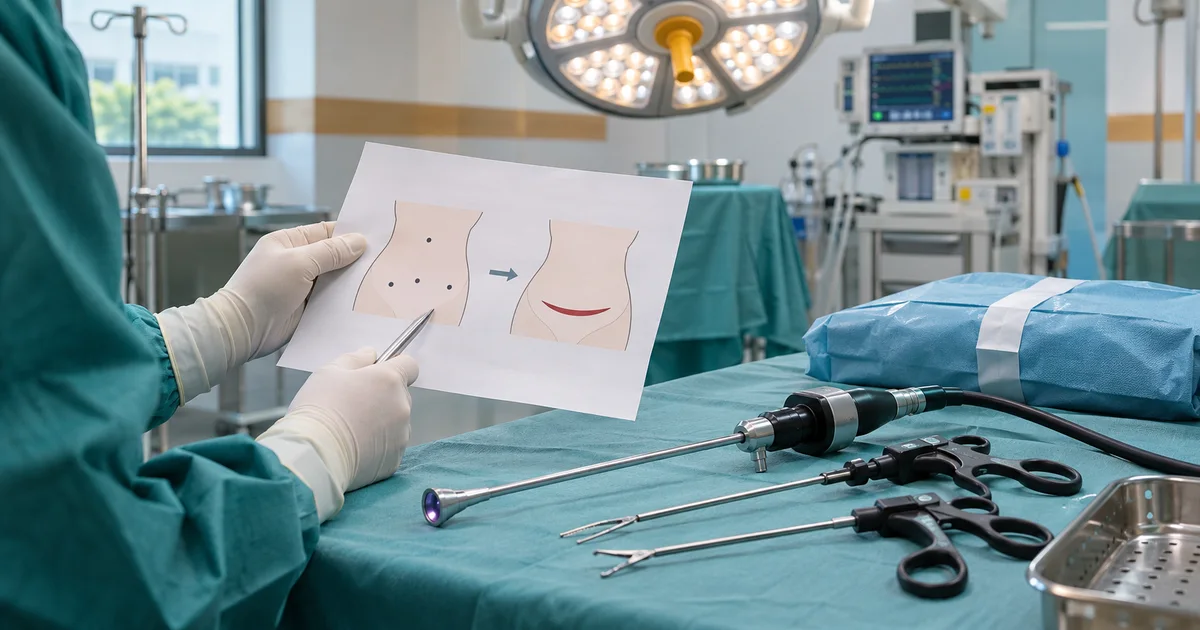
Your surgeon has recommended keyhole surgery. You've discussed the small incisions, how long you might stay in hospital and what recovery could involve. Then, during the consent discussion, you hear something unexpected.
"If we cannot continue safely through keyhole surgery, we may need to make a larger incision."
That can be unsettling. You were preparing for one kind of operation, so why is another being discussed?
A laparoscopic surgeon may sometimes need to switch from keyhole surgery to an open operation because of unexpected bleeding, internal scar tissue, difficult anatomy or findings that make the original approach unsuitable. The decision is known as conversion to open surgery, or conversion to laparotomy.
It does not automatically mean something went wrong. Sometimes conversion is needed to manage a complication; at other times, the decision is made before an injury occurs.
For women considering gynecological procedures, Dr Vinita Khemani's website explains the scope of keyhole surgery for selected uterine and pelvic conditions and the types of operations that may be considered after clinical assessment.
Understanding why a change of approach may become necessary can help you have a more informed conversation before surgery.
Can a Laparoscopic Surgeon Change to Open Surgery During an Operation?
Yes. A laparoscopic operation may need to become open surgery if the surgeon cannot safely complete the planned procedure through small incisions. The decision depends on what is found during surgery, whether important structures can be clearly identified and whether bleeding or another difficulty requires a different approach.
Common reasons include:
- Dense internal scar tissue, known as adhesions
- Bleeding that is difficult to control laparoscopically
- Difficulty identifying the bowel, bladder, ureters or blood vessels
- Large or complex disease that restricts safe access
- Unexpected findings not fully apparent on scans
- A suspected injury requiring inspection or repair
Conversion is a recognised possibility in laparoscopic surgery, but it is not inevitable. The likelihood varies with the procedure, the patient's condition and operative findings.
What Changes When Keyhole Surgery Becomes Open Surgery?
During laparoscopy, the surgeon operates through small abdominal incisions using a camera and specially designed instruments. Carbon dioxide gas is usually introduced into the abdomen to create space for the operation.
The camera gives a magnified view of the internal structures. This can be helpful when operating around delicate pelvic tissues.
Open surgery is different. The surgeon makes a larger abdominal incision to gain more direct access to the area being treated.
The larger opening may provide better access for controlling bleeding, separating difficult tissues, examining an organ or completing a procedure that cannot be performed appropriately through laparoscopic instruments.
It is not a matter of one technique always being better than the other.
Keyhole surgery may offer advantages in recovery for appropriately selected patients. Open surgery can be necessary when direct access offers a more suitable way to manage the findings encountered during the operation.
The important question is why the approach changed in that particular case.
How Internal Scar Tissue Can Change the Surgical Plan
Consider someone who has undergone abdominal or pelvic surgery in the past.
The previous operation may have healed well, and the patient may have no continuing symptoms. Yet inside the abdomen, bands of scar tissue can sometimes connect structures that would normally move separately.
These bands are called adhesions.
Some are thin and can be separated with laparoscopic instruments. Others are dense, extensive or closely attached to the bowel, bladder or pelvic blood vessels.
A surgeon working in this area must be able to distinguish one structure from another before cutting or separating tissue.
When adhesions obscure the usual boundaries, continuing through small incisions may become increasingly difficult.
Changing to an open approach can sometimes provide more room to inspect and separate the tissues.
Previous surgery does not automatically mean conversion will be necessary. But operative records are useful because they may tell the surgeon where previous incisions were made, which organs were involved and whether significant adhesions were reported.
Why Unexpected Bleeding May Require a Larger Incision
Bleeding can occur during both laparoscopic and open operations. In many cases, it can be controlled without changing the surgical approach.
The difficulty arises when the source of bleeding cannot be identified clearly or controlled effectively through laparoscopic instruments.
Blood can obstruct the camera's view. The operating area may also become more difficult to navigate while the team assesses the patient's circulation and blood loss.
In that situation, a larger incision may give the surgeon more direct access to the affected area.
Conversion may be part of managing an actual surgical complication, but conversion itself does not tell you whether a complication occurred.
The American College of Obstetricians and Gynecologists' patient guidance on laparoscopy explains that unexpected findings or complications can occasionally require open surgery.
The circumstances matter. A surgeon may change the approach because bleeding has occurred, or because continued laparoscopic dissection presents an unacceptable risk of injury.
These are different situations, even though both may lead to an open operation.
When the Anatomy Is More Difficult Than Expected
Scans help surgeons plan an operation, but they do not reveal every detail inside the abdomen.
A fibroid may be larger or more difficult to access than anticipated. Severe endometriosis or previous inflammation may alter the position of pelvic organs. Internal scar tissue can make normal anatomical boundaries difficult to recognise.
These differences become particularly important around the bowel, bladder and ureters.
The ureters are narrow tubes that carry urine from the kidneys to the bladder. They pass close to structures involved in certain gynecological operations.
A clear understanding of their position helps the surgeon avoid injury.
If normal anatomy cannot be identified reliably, continuing with the original approach may create unnecessary risk.
Sometimes a larger incision provides better access. In other situations, the surgeon may modify the planned procedure or decide that a different treatment strategy is appropriate.
Not every unexpected finding requires conversion. The decision depends on the operative circumstances and the limits of the patient's informed consent.
Situations That May Require Conversion to Open Surgery
| Situation during surgery | Main concern | Why the approach may change |
|---|---|---|
| Dense adhesions | Bowel or other organs may be attached to surrounding tissue | A larger incision may improve access for careful dissection |
| Significant bleeding | The bleeding source may be difficult to see or control | Direct access may help identify and treat the source |
| Distorted pelvic anatomy | Important organs or vessels may not be clearly identifiable | Changing the approach may allow safer identification |
| Large or complex disease | Instruments may have limited working space | Open access may make the planned treatment more manageable |
| Unexpected findings | The original surgical plan may no longer be appropriate | The procedure may need reassessment or modification |
| Suspected organ injury | The affected structure may require inspection or repair | Open surgery may sometimes help manage the injury |
These examples illustrate possible operative decisions. They cannot predict whether conversion will be necessary for an individual patient.
Does Conversion Mean the Operation Has Failed?
No. A change from laparoscopic to open surgery does not automatically mean the operation has failed.
Suppose the surgeon discovers dense adhesions around the bowel. There may be no injury or active bleeding, but separating the tissues further through laparoscopic instruments could be difficult.
A decision to change the approach before continuing may help avoid an injury.
Now consider a different situation: unexpected bleeding develops during surgery, and the team converts to open surgery to control it.
Here, conversion is part of managing a complication that has already occurred.
Both situations may result in a larger incision, but they have different clinical explanations.
That is why conversion should not automatically be celebrated as evidence of good surgical judgment or labelled as surgical failure.
The operative findings, reason for conversion, actions taken and patient's outcome all need to be considered.
What Should Your Surgeon Explain Before You Sign Consent?
The possibility of conversion is best discussed before surgery, while you have time to understand the plan.
Your surgeon should explain why laparoscopy is being recommended, which alternatives are reasonable and what circumstances might make an open approach necessary.
You should also understand the possible implications for recovery, hospital stay and complications.
An additional point often gets overlooked: agreeing to possible conversion is not unlimited permission for every unrelated procedure.
The scope of consent matters. Unexpected findings may sometimes require decisions about whether to continue, modify or defer parts of an operation, depending on urgency and applicable consent requirements.
The International Federation of Gynecology and Obstetrics' best-practice guidance on surgical consent discusses the need for clear communication about material risks, alternatives and possible conversion to laparotomy.
Before consenting, make sure you understand the intended operation and what changes the surgical team may reasonably need to consider.
Can Conversion Be Predicted Before Surgery?
Sometimes a surgeon can identify factors that make an operation more technically demanding.
Previous abdominal operations, extensive endometriosis, a large uterus or multiple fibroids may influence planning.
Ultrasound, MRI when indicated, and earlier operative records may provide useful information.
However, these investigations cannot always reveal the extent of adhesions or the precise relationship between tissues.
Some difficulties become clear only after the operation has started.
This does not mean preoperative planning has no value. It means even careful planning has limits.
A realistic surgical discussion should acknowledge both what is known before the operation and what may remain uncertain until the surgeon can examine the area directly.
Will Recovery Take Longer After Open Surgery?
Recovery may be different if an operation planned as laparoscopy becomes open surgery.
A larger incision can involve more wound discomfort, different activity restrictions and a longer hospital stay. The amount of additional recovery time varies.
Someone whose operation was converted because of difficult access may have different postoperative needs from someone who required treatment for significant bleeding or organ injury.
The procedure performed also matters.
Your discharge instructions should reflect the operation you actually underwent, not merely the one that was originally planned.
Ask the hospital team about wound care, pain medication, walking, lifting, returning to work and follow-up appointments.
Seek medical advice promptly for symptoms such as fever, worsening abdominal pain, increasing wound redness or discharge, persistent vomiting, chest pain or breathlessness.
The surgical team should provide clear instructions about which symptoms require urgent attention after discharge.
Choosing a Laparoscopic Gynecological Surgeon in Kolkata
If you have been advised to undergo laparoscopic surgery in Kolkata, it is natural to ask whether the operation can be completed through small incisions.
But the consultation should also help you understand what happens when the original plan is no longer appropriate.
A laparoscopic gynecological surgeon in Kolkata should be able to explain the proposed procedure, why it suits your condition, the material risks, reasonable alternatives and the possibility of conversion.
You can also discuss how the hospital is equipped to manage unexpected bleeding, organ injury or other findings, and what arrangements exist for additional surgical support when required.
Dr Vinita Khemani's published information describes laparoscopic approaches used for selected gynecological conditions. The suitability of a particular procedure still requires individual assessment and informed consent.
Choosing surgical care should involve reviewing verified qualifications, the proposed operation and the hospital facilities—not simply expecting every keyhole procedure to be completed without a larger incision.
Frequently Asked Questions
Can my laparoscopic surgeon decide to perform open surgery during the operation?
Yes, a surgeon may convert a laparoscopic operation to an open procedure if continuing through small incisions is no longer appropriate. Reasons can include dense adhesions, significant bleeding or anatomy that cannot be identified clearly. Discuss this possibility and its implications before signing consent.
Does switching from laparoscopic to open surgery mean something went wrong?
No, conversion does not always mean a complication or surgical error occurred. It may be a precaution taken before injury, or it may be necessary to manage an unexpected complication. Ask your surgeon to explain the operative findings and reason for conversion afterwards.
Can previous abdominal surgery increase the chance of conversion?
Yes, previous abdominal surgery can be associated with adhesions that make some laparoscopic operations more difficult. However, many patients with previous operations can still undergo successful laparoscopy. Bring earlier surgical records so your surgeon can consider them during planning.
Will recovery be longer if my keyhole surgery becomes open surgery?
Recovery can take longer after conversion because a larger abdominal incision may require additional healing. The actual recovery depends on the procedure, the reason for conversion and whether complications occurred. Follow the instructions given for your completed operation and attend the recommended follow-up.
Before Surgery, Make Sure You Understand Both Approaches
Preparing for keyhole surgery involves more than knowing where the incisions will be made.
It means understanding why the surgeon recommends laparoscopy, what might make an open approach necessary and how that decision could affect the operation and recovery.
Bring your previous surgical records, discuss any concerns raised by your scans and ask how unexpected findings would be handled.
You may never need the alternative approach. But knowing why it is sometimes considered helps you give informed consent without assuming that conversion automatically means failure.
A well-explained surgical plan should cover not only the intended operation, but also the decisions that may become necessary when circumstances change.
Medical Disclaimer: This article provides general educational information and does not replace individual surgical consultation, informed consent or medical advice. The decision to perform laparoscopic or open surgery depends on the planned procedure, medical history, operative findings, available facilities and clinical judgment. Conversion may occur with or without a surgical complication. No surgical method can guarantee a particular outcome, incision size or recovery period.
Have questions about this topic?
Book a consultation with Dr. Vinita Khemani to address your specific concerns and get a personalized care plan.