
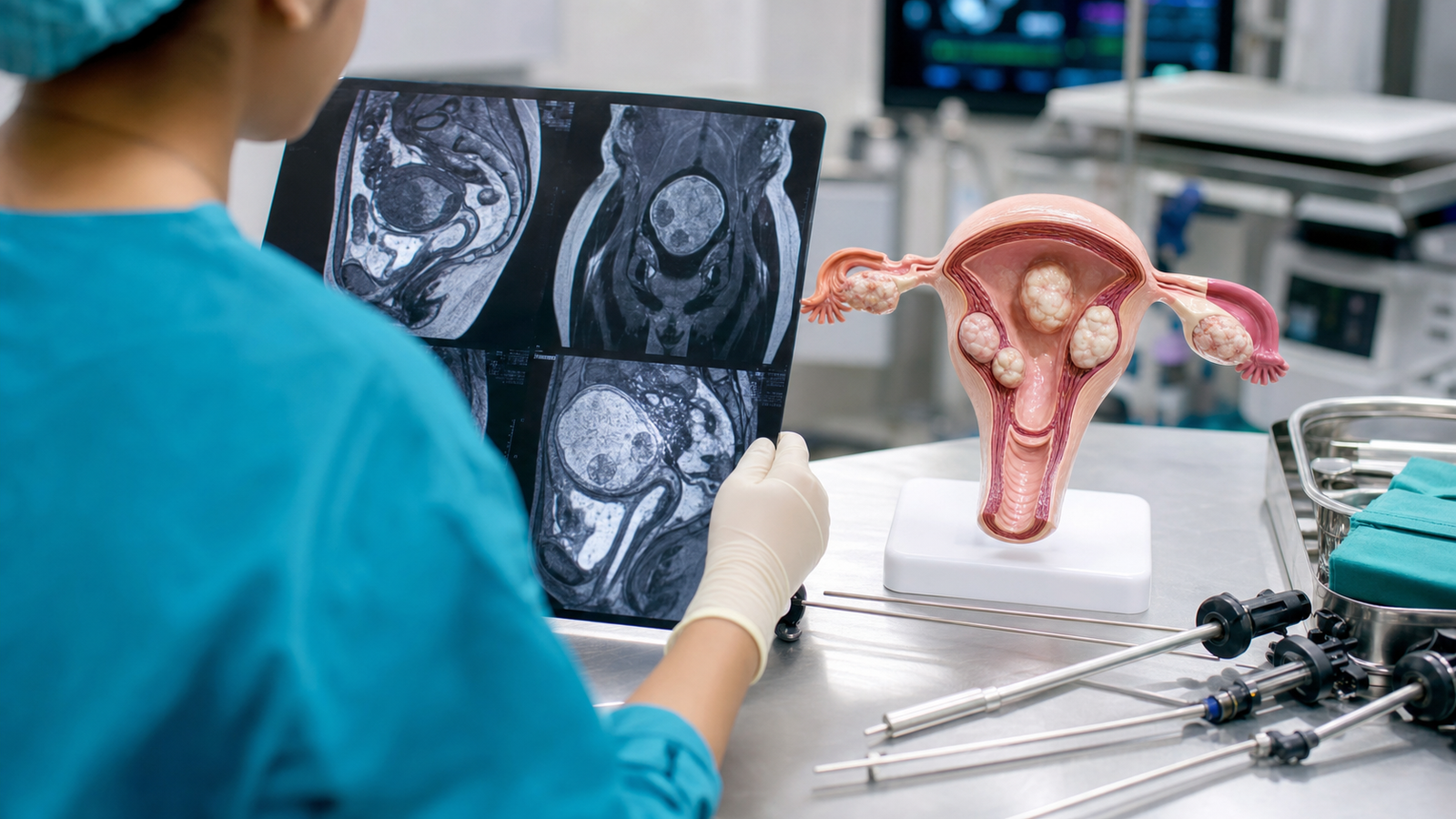
A fibroid diagnosis can make a woman anxious very quickly. The scan report may mention one fibroid, multiple fibroids, or a size that sounds frightening. Then comes the bigger worry: “Will I need major surgery?”
Many women now ask whether laparoscopic surgery in Kolkata can remove fibroids without a large abdominal cut. In some cases, yes. But not every fibroid is suitable for keyhole removal. The decision depends on the fibroid’s size, position, number, bleeding pattern, fertility plans, previous surgery history, and whether the uterus can be repaired safely.
At Dr Vinita Khemani’s clinic, fibroid surgery planning does not start and end with the ultrasound size. It starts with the patient’s symptoms. Heavy bleeding, pelvic pressure, anemia, pain, fertility concerns, and pregnancy plans all change the conversation. If you are trying to understand whether a minimally invasive route is possible, this page on advanced Laparoscopic procedures for fibroid and pelvic conditions explains how surgical planning is approached.
Can fibroids be removed by laparoscopic surgery?
Yes, fibroids can sometimes be removed by laparoscopic surgery when their size, number, and location make the procedure safe. In laparoscopic myomectomy, fibroids are removed while the uterus is preserved, but the surgeon must also be able to control bleeding and repair the uterus properly. Very large fibroids, multiple deep fibroids, dense adhesions, or complex uterine repair may make open surgery safer.
A simple way to understand suitability:
| Patient Situation | What May Be Discussed |
|---|---|
| One or few accessible fibroids | Laparoscopic myomectomy may be possible |
| Heavy bleeding with anemia | Bleeding control and hemoglobin correction may be needed before surgery |
| Fibroid affecting fertility | Uterus-preserving myomectomy may be considered |
| Multiple very large fibroids | Open surgery may be safer in some cases |
| Completed family with severe recurring symptoms | Hysterectomy may be discussed after counselling |
| Previous abdominal surgery | Adhesions may affect the surgical route |
This is why a scan report alone is not enough. The same 5 cm fibroid may mean different things in two different women.
Why fibroid surgery is not decided only by size
Many women come to the clinic worried about one number on the ultrasound report.
“My fibroid is 6 cm. Does that mean I need surgery?”
It is a fair question. But fibroid treatment is not decided by size alone. A smaller fibroid sitting close to the uterine cavity may cause heavy bleeding or create fertility-related concerns. A larger fibroid growing outward may mainly cause pressure, bloating, or frequent urination. Some women have multiple fibroids and barely feel anything. Others have one fibroid and struggle with heavy bleeding every month.
That is why the more useful question is not just, “How big is the fibroid?”
It is, “What is this fibroid doing to my body?”
Surgery may be discussed when fibroids cause heavy periods, low hemoglobin, pelvic pressure, painful cycles, urinary frequency, difficulty conceiving, repeated miscarriage, or symptoms that keep coming back despite medicines. Some fibroids only need monitoring. Some may respond to medical treatment. Some need surgical removal.
This is also where the difference between myomectomy and hysterectomy matters. Myomectomy removes the fibroid while keeping the uterus in place. Hysterectomy removes the uterus and may be discussed only when it fits the woman’s age, symptoms, family plans, and medical situation. ACOG’s patient guidance explains this distinction clearly in its resource on uterine fibroids.
When keyhole myomectomy may be possible
Keyhole myomectomy, also called laparoscopic myomectomy, may be possible when the surgeon can safely reach the fibroid through small cuts and repair the uterus well afterward.
This route is more likely when the fibroid is accessible, the number of fibroids is limited, imaging is clear, and the patient is fit for minimally invasive surgery. A fibroid on the outer surface of the uterus may be easier to approach than a deeply embedded fibroid surrounded by important blood vessels.
Fibroid myomectomy is one of the advanced laparoscopic procedures where planning depends heavily on imaging, uterine repair, bleeding control, and the patient’s fertility goals. It is not just about making smaller cuts. It is about doing the operation safely through those smaller cuts.
Mayo Clinic also explains that laparoscopic myomectomy uses small abdominal incisions and specialized instruments to remove fibroids in selected patients. You can read their overview here: Mayo Clinic — Myomectomy.
Heavy bleeding is often the symptom women tolerate too long
Many women quietly adjust their lives around fibroid bleeding.
They carry extra pads. They avoid travel during periods. They cancel meetings. Some pass large clots. Some become tired, dizzy, or breathless because their hemoglobin has dropped over time.
That is not something to normalize.
If periods are heavy enough to disturb work, sleep, energy, or daily confidence, evaluation is needed. The doctor may review ultrasound findings, hemoglobin level, iron status, age, bleeding pattern, and whether the fibroid is close to the uterine cavity.
Surgery is not always the first answer. But when bleeding continues, anemia worsens, or medicines do not help enough, fibroid surgery may become part of the discussion.
Fertility concerns: why myomectomy may be preferred
For women who want pregnancy in the future, myomectomy may be discussed because it removes fibroids while preserving the uterus.
Not every fibroid affects fertility. Some are small and sit away from the uterine cavity. Others may distort the cavity, affect implantation, or increase the chance of pregnancy-related problems depending on their position. This is why the exact location matters so much.
A woman trying to conceive should not decide from the ultrasound report alone. The discussion should include age, ovarian reserve, pregnancy history, miscarriages if any, partner factors, fibroid location, and whether the uterine cavity is affected.
For women searching for a laparoscopic myomectomy doctor in Kolkata, one of the most important questions is: “Can the fibroid be removed and the uterus repaired safely?” Removal matters. Repair matters just as much.
Myomectomy and hysterectomy are not the same surgery
Patients sometimes hear “fibroid surgery” and assume it means uterus removal. That is not always true.
Myomectomy removes fibroids and keeps the uterus. Hysterectomy removes the uterus. Both may be valid surgical options, but they are used for different situations and different patient goals.
Myomectomy is usually considered when a woman wants to preserve the uterus, is planning pregnancy, or prefers uterus-conserving treatment if medically suitable. Hysterectomy may be discussed when fibroids are severe, recurring, multiple, or when the woman has completed her family and wants a definitive solution after understanding the implications.
A 32-year-old trying for pregnancy and a 48-year-old with years of heavy bleeding may not need the same operation. A good consultation should explain the trade-offs clearly, not push one route for everyone.
When open surgery may be safer
Many patients feel disappointed if they are told keyhole surgery may not be ideal. That reaction is natural. Smaller cuts sound easier, and recovery is often a major concern.
But the safest surgery is not always the smallest-looking surgery.
Open surgery may be safer when fibroids are very large, numerous, deeply placed, difficult to access, or when secure uterine repair would be difficult through laparoscopy. Previous abdominal surgeries may also cause adhesions that make keyhole surgery more complex. If bleeding risk is high, the surgeon may advise a route that gives better control.
A laparoscopic surgery doctor should decide the route after reviewing the scan, symptoms, hemoglobin level, previous surgery history, examination findings, and whether the uterus needs to be preserved.
This is where honest counselling matters. A safe surgical plan is better than a fashionable surgical label.
What recovery may feel like after laparoscopic fibroid surgery
Recovery after laparoscopic myomectomy is usually easier than open surgery for many suitable patients, but it should not be treated as a small procedure. The cuts are smaller, but the uterus still needs time to heal from inside.
Most women are encouraged to start walking soon after surgery, often under medical guidance. Light activities may resume gradually, but recovery is not the same for everyone. A woman who had one accessible fibroid removed may feel better sooner than someone who needed deeper uterine repair, had more blood loss, or started surgery with low hemoglobin.
After discharge, the focus is usually on simple but important things: keeping the wound clean, taking medicines correctly, avoiding heavy lifting, watching bleeding or pain, and attending follow-up visits. If pregnancy is part of the future plan, the doctor will also discuss when it may be safe to try and whether any special precautions may be needed in a later pregnancy.
Before surgery, it helps to ask the questions patients actually worry about: “When can I return to work?” “Can I climb stairs?” “When can I exercise again?” “When is it safe to plan pregnancy?” “Which symptoms should make me call the doctor immediately?”
A clear recovery plan makes the surgery feel less frightening. You know what is expected, what is normal, and what should not be ignored.
Bring these reports to your fibroid surgery consultation
A consultation becomes more useful when the doctor can see the full picture.
Carry your latest pelvic ultrasound report. If an MRI has been advised, bring that too. Bring hemoglobin and iron reports if heavy bleeding has been an issue. Carry previous prescriptions, details of medicines already tried, old scan reports, surgery notes if you had prior abdominal surgery, and your menstrual history.
Also be clear about pregnancy plans. This changes the surgical conversation.
A patient who wants pregnancy may need a uterus-preserving plan. A patient who has completed her family may want to understand both myomectomy and hysterectomy. A patient with anemia may need correction before surgery is scheduled.
The more specific your information, the more specific the surgical advice can be.
Book a fibroid surgery opinion if symptoms are affecting your life
A fibroid does not need surgery only because it exists. But it should not be ignored if it is causing real problems.
Book a consultation if you have heavy bleeding with clots, repeated anemia, pelvic pressure, frequent urination, painful periods, difficulty conceiving, repeated miscarriage, a fibroid growing on repeat scans, or confusion about whether myomectomy or hysterectomy is right for you.
This is also useful if one doctor has advised open surgery and you want to understand whether keyhole surgery is possible. A second opinion does not mean you are rejecting treatment. It means you are trying to understand the safest route.
Doctor’s insight: the scan is only the starting point
At Dr Vinita Khemani’s clinic, we do not treat the scan report in isolation. We look at the woman sitting in front of us.
Some patients are scared because the report says “multiple fibroids.” Some are surprised that a smaller fibroid can cause heavy bleeding. Some want pregnancy and are worried that surgery may affect the uterus. Some have already been told they need hysterectomy and want to know if uterus-preserving surgery is still possible.
These are not the same consultations.
Fibroid surgery planning has to respect symptoms, fertility goals, safety, and recovery. The aim is not simply to remove growth. The aim is to choose a treatment route that solves the actual problem without creating avoidable risk.
FAQs
Can a large fibroid be removed by keyhole surgery?
A large fibroid can sometimes be removed by keyhole surgery, but suitability depends on size, position, number of fibroids, bleeding risk, and surgical judgement. Very large, multiple, or deeply placed fibroids may require open surgery for safer removal and uterine repair. Carry your ultrasound or MRI report to a gynecologic surgeon so the route can be assessed properly.
Is laparoscopic myomectomy better than open myomectomy?
Laparoscopic myomectomy may offer smaller cuts, less wound discomfort, and faster recovery in suitable patients. Open myomectomy may be safer when fibroids are very large, numerous, difficult to access, or when uterine repair is expected to be complex. The better option is the one that removes the fibroid safely and protects long-term health.
Can I get pregnant after fibroid removal surgery?
Pregnancy may be possible after myomectomy if the uterus is preserved and other fertility factors are favorable. The timing of pregnancy after surgery depends on the depth of uterine repair, fibroid location, age, ovarian reserve, and the surgeon’s advice. Ask your doctor when it is safe to try and whether future pregnancy or delivery needs special planning.
When should I not delay fibroid treatment?
Do not delay evaluation if fibroids are causing very heavy bleeding, anemia, severe pelvic pressure, fertility concerns, repeated miscarriage, or rapidly worsening symptoms. These signs may need ultrasound review, blood tests, medical treatment, or surgical planning. Book a consultation if periods are affecting work, sleep, energy, or pregnancy plans.
A practical next step
Fibroid surgery without a big cut may be possible, but it should never be decided by hope alone. The right route depends on where the fibroid is, how many there are, what symptoms you have, whether you want pregnancy, and whether the uterus can be repaired safely.
If your ultrasound report mentions fibroids and you are worried about heavy bleeding, fertility, pressure symptoms, or whether keyhole surgery is possible, book a consultation with Dr Vinita Khemani. Carry your scan report, hemoglobin test, previous prescriptions, and pregnancy plans so the surgical route can be discussed clearly.
Medical disclaimer: This article is for general patient education only and should not be treated as personal medical advice, diagnosis, or treatment guidance. Fibroid treatment decisions depend on age, symptoms, fertility goals, examination findings, imaging, blood reports, medical history, anesthesia fitness, and surgical risk assessment. Please consult a qualified gynecologist or laparoscopic surgeon for individualized evaluation and treatment planning.
Have questions about this topic?
Book a consultation with Dr. Vinita Khemani to address your specific concerns and get a personalized care plan.