

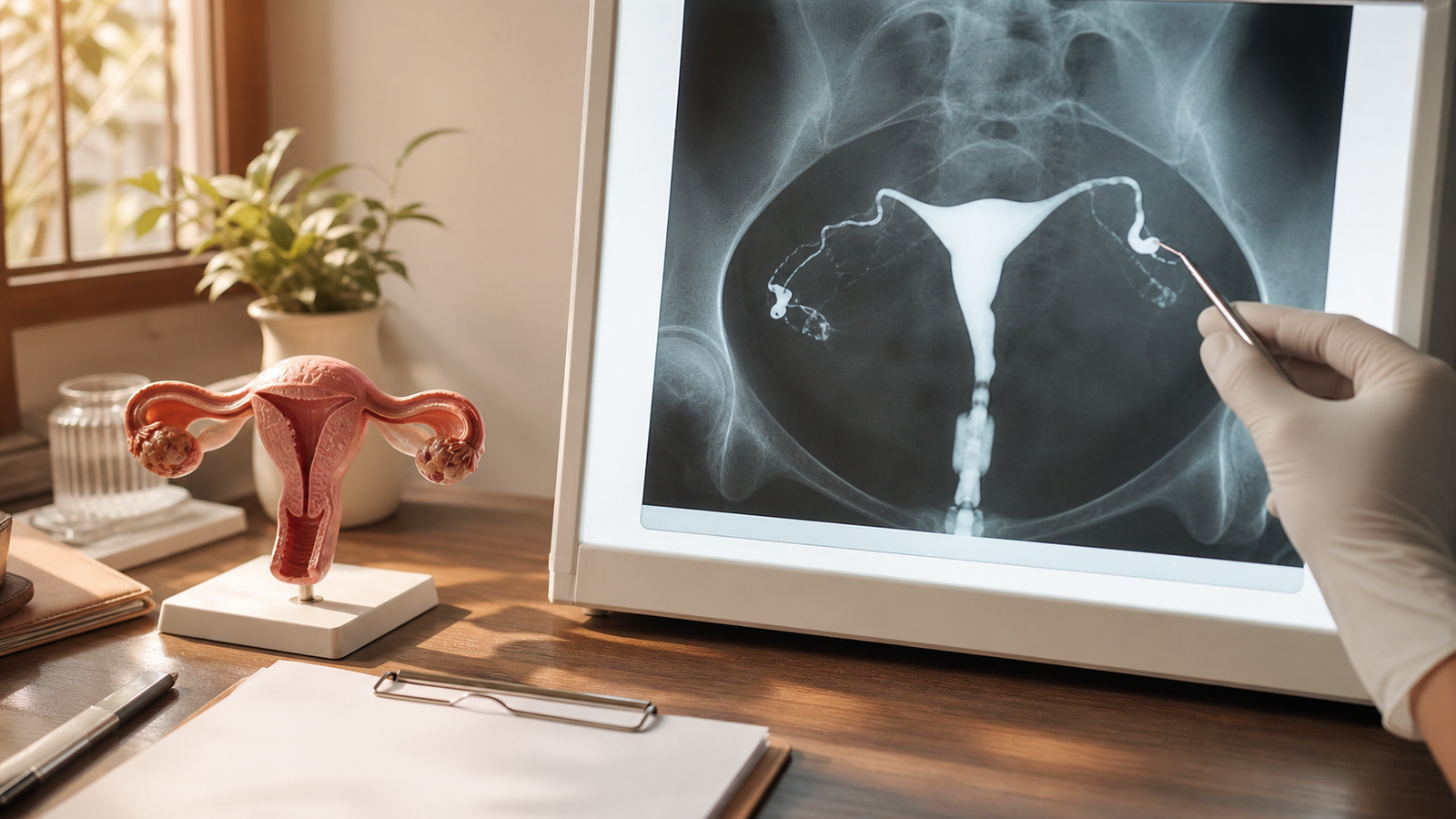
An HSG report showing one blocked fallopian tube can be frightening. Many women see the word “blocked” and immediately assume that natural pregnancy is no longer possible.
That is not always the case.
If the other tube is open and healthy, pregnancy may still happen naturally. What matters is not only whether a blockage appears on the report, but where it is located, what may have caused it and whether any other fertility factor is present.
For women who need their reports reviewed as part of a complete fertility assessment, Dr. Vinita Khemani offers personalised fertility management in Kolkata, where the HSG result is considered alongside age, ovulation, ovarian reserve, ultrasound findings and semen health rather than interpreted in isolation.
Can You Get Pregnant Naturally With One Blocked Fallopian Tube?
Yes, natural pregnancy may be possible when the other tube is open, structurally healthy and able to pick up the egg. The likelihood also depends on your age, ovulation pattern, sperm health, the condition of the ovaries and whether endometriosis, pelvic adhesions or hydrosalpinx is present.
A more favourable situation usually means:
- Dye passes freely through the open tube during the HSG test.
- There is no hydrosalpinx or major tubal damage.
- Ovulation is occurring regularly.
- The semen analysis is reassuring.
- There is no significant endometriosis or history of severe pelvic infection.
- The couple has a clear, time-bound plan rather than being told to keep trying indefinitely.
One open tube may be enough. Still, the word “open” does not tell us everything about how well that tube functions.
What Does an HSG Test Actually Tell You?
A hysterosalpingogram, commonly called an HSG test, uses contrast dye and X-ray imaging to examine the shape of the uterine cavity and check whether the fallopian tubes allow the dye to pass through.
The test is useful, but it is not a complete fertility diagnosis.
The World Health Organization’s infertility guideline includes tubal assessment as part of evidence-based fertility evaluation and recommends interpreting test findings within the couple’s complete clinical picture.
When reviewing an HSG, three details deserve careful attention.
Where is the suspected blockage?
A proximal blockage is located close to the uterus. Sometimes, this appearance is caused by temporary muscular spasm, mucus or technical factors during the test rather than permanent damage.
A distal blockage is found near the outer end of the tube, close to the ovary. This finding is more likely to be connected with previous infection, adhesions or damage around the fimbrial end—the part that normally helps collect the egg.
These two findings should not be treated as though they mean the same thing.
Does the other tube show free spill?
An HSG report may use the phrase “free peritoneal spill.” In simple terms, this means the dye travelled through the tube and came out through its open end.
That is reassuring. However, an HSG cannot directly show whether the delicate inner lining and microscopic cilia inside the tube are working normally.
A tube may allow dye to pass but still be affected by previous infection, pelvic surgery or endometriosis. This is why the report must be read together with the woman’s history and ultrasound findings.
Is there a hydrosalpinx?
Hydrosalpinx is more than a routine blockage. It means that a damaged tube has become swollen and filled with fluid, usually because the outer end is closed.
This finding can alter the fertility plan even when the opposite tube appears open. It is particularly relevant before IVF because fluid from a hydrosalpinx may affect implantation.
The American Society for Reproductive Medicine identifies HSG as a standard first-line test for tubal patency while also noting its limitations, including false-positive findings in some cases of proximal blockage. Its guidance also treats hydrosalpinx as a separate clinical issue requiring specific management.
What Really Affects Your Chance of Pregnancy?
Patients understandably ask, “What is my percentage chance?”
A reliable answer cannot be calculated from the HSG report alone. The following factors often matter more than the simple statement that one tube is blocked.
1. The condition of the open tube
One healthy tube can provide a route for the sperm and egg to meet. But its appearance, shape and spill pattern should be reviewed carefully.
A woman whose open tube shows free spill and no obvious damage is in a different situation from someone whose remaining tube looks irregular or is surrounded by adhesions.
2. Your age and the time already spent trying
A tubal blockage affects transport. Age affects egg number, egg quality, miscarriage risk and the time available to continue trying.
For example, a 28-year-old who has been trying for six months may be advised differently from a 38-year-old who has already been trying for two years—even when their HSG reports look similar.
Current fertility guidance generally recommends evaluation after 12 months of regular unprotected intercourse for women under 35 and after six months for women aged 35 or older. Earlier assessment may be appropriate when a known fertility-related condition, including tubal disease, is already present.
3. Whether you are ovulating
Women with regular cycles between roughly 21 and 35 days are often ovulating, so repeated tests are not automatically necessary simply because one tube is blocked.
Follicular monitoring may be useful in selected cases when knowing how a follicle is developing would genuinely influence a time-limited plan. It should have a clear purpose, not become a routine series of scans without a decision point.
4. Semen health
A blocked tube is only one part of a couple’s fertility picture.
If sperm concentration, movement or shape is significantly affected, relying on a single functional tube may reduce the overall chance further. A semen analysis is therefore usually included early rather than waiting several months and assuming the problem lies only with the woman.
5. Endometriosis, infection or pelvic surgery
Endometriosis can affect the relationship between the ovary and fallopian tube, even when dye appears to pass through during the HSG.
Previous pelvic inflammatory disease, an ectopic pregnancy, appendix surgery or another pelvic operation may also lead to scarring around the tubes.
Tell your doctor if you have experienced:
- Severe period pain
- Pain during intercourse
- Previous pelvic infection
- An earlier ectopic pregnancy
- Surgery involving the abdomen or pelvis
These details may explain why conception is taking longer despite one apparently open tube.
Should You Try Naturally, Consider IUI or Discuss IVF?
There is no single treatment route for every woman whose HSG shows one tube blocked and one tube open. The next step should reflect the entire fertility assessment.
When trying naturally may be reasonable
A limited period of natural trying may be sensible when:
- The open tube has a reassuring appearance and free spill.
- Menstrual cycles are regular.
- Semen parameters are satisfactory.
- There is no hydrosalpinx or significant endometriosis.
- Age and ovarian reserve allow time for a natural attempt.
Timing intercourse every one to two days during the fertile window is usually more practical than trying to identify one exact hour of ovulation. Couples should also agree on when they will return for review.
“Try for a few more months” is useful advice only when the couple knows how many months, why waiting remains reasonable and what will happen next if pregnancy does not occur.
When IUI may be discussed
Intrauterine insemination places prepared sperm directly inside the uterus. It does not bypass the fallopian tubes, so at least one functional tube is still needed.
IUI may be considered in selected cases, particularly when the open tube appears healthy and there are no major additional fertility factors. The location of the blocked segment, the woman’s age, ovarian response and semen results all influence whether it is a sensible option.
A proximal blockage caused by possible spasm is not the same clinical situation as a damaged distal tube or hydrosalpinx.
When IVF may become the more efficient route
IVF bypasses the fallopian tubes because fertilisation takes place outside the body before an embryo is placed in the uterus.
It may be discussed when:
- Age or ovarian reserve makes prolonged waiting unwise.
- The apparently open tube is also abnormal.
- Hydrosalpinx is present.
- Significant male-factor infertility is found.
- Endometriosis or pelvic adhesions are affecting fertility.
- Previous natural attempts or appropriate treatment have not worked.
IVF is not automatically required simply because one tube appears blocked. Equally, continuing to try naturally for years is not always the safest use of reproductive time.
Doctor’s Insight: Do Not Treat One Line in the Report
An HSG report may say “left cornual block,” “right distal occlusion” or “no spill on one side.” Those phrases sound definitive, but they do not all carry the same meaning.
The first useful question is not simply, “Which tube is blocked?”
A better set of questions is:
- Is the finding proximal or distal?
- Could the apparent blockage be caused by temporary spasm?
- Does the open tube show normal free spill?
- Is there any sign of hydrosalpinx?
- Are age, ovulation and semen results favourable?
- How long has the couple already been trying?
Two women with almost identical HSG wording may need very different plans. One may reasonably try naturally for a defined period. Another may need the images reviewed, further evaluation or a faster discussion about assisted conception.
This is why fertility management works best when the patient is treated as a whole person—not as an HSG report.
What Should You Take to Your Fertility Appointment?
Bring the actual HSG images when possible, not only the written report. The images may help the doctor understand the site of the blockage, the shape of the tubes and the pattern of dye spill.
Also carry:
- Previous ultrasound reports
- Menstrual-cycle dates
- Details of past pregnancies or miscarriages
- Records of pelvic infections or surgery
- Recent hormone and ovarian-reserve reports, if already performed
- A current semen analysis for the male partner
Before leaving the consultation, ask for a plan that answers three practical questions:
What does the blockage most likely mean?
What should we do now?
When should the plan be reviewed?
That clarity can prevent months of uncertainty and repeated treatment without a defined goal.
Frequently Asked Questions
Can I conceive naturally if my HSG shows one tube blocked and one tube open?
Yes, natural conception is possible when the open tube is healthy, ovulation is occurring and semen parameters are satisfactory. Age, hydrosalpinx, endometriosis and the condition of the remaining tube may reduce the chance. Ask for the HSG images and the couple’s full fertility findings to be reviewed together.
Does an HSG always confirm that a fallopian tube is permanently blocked?
No, an apparent proximal blockage may sometimes be caused by temporary spasm, mucus or technical factors during the procedure. A distal blockage, abnormal tube shape or hydrosalpinx is more likely to indicate structural damage. Your doctor can decide whether image review or another assessment would change the treatment plan.
Can IUI work if only one fallopian tube is open?
Yes, IUI can work when at least one tube is functional because sperm and egg still need to meet inside the reproductive tract. Its suitability depends on the type of blockage, age, ovarian response and semen quality. A time-bound fertility plan can clarify whether IUI is reasonable or whether another route would be more efficient.
When should IVF be considered after a blocked-tube diagnosis?
IVF may be considered when the remaining tube is also damaged, hydrosalpinx is present, male-factor infertility is significant or age makes waiting less favourable. It may also be discussed after appropriate natural attempts or simpler treatment have not succeeded. The decision should be based on the complete fertility assessment rather than the HSG result alone.
Your Next Step Should Be Clear, Not Fear-Driven
Seeing a blocked tube on an HSG report does not automatically close the door to pregnancy. For many women, one healthy tube may still provide a real opportunity to conceive.
What you need next is not a promise or a generic success percentage. You need a careful review of the images, an assessment of both partners and an honest timeline.
A useful fertility plan should tell you whether natural trying remains reasonable, how long to continue and what finding would lead to a change in approach. That is far more valuable than simply being told to wait and hope.
Medical Disclaimer:
This article is intended for general education and does not replace a personalised medical consultation, examination or treatment plan.
Have questions about this topic?
Book a consultation with Dr. Vinita Khemani to address your specific concerns and get a personalized care plan.