
Advanced Hysteroscopy
& Uterine Evaluation in Kolkata.
A revolutionary diagnostic and treatment method that allows Dr. Khemani to see and treat inside the womb without a single incision. As a specialist in Day-care hysteroscopy, Dr. Khemani is also a uterine polyp removal specialist, offering gold standard care for abnormal bleeding and infertility.
See Without Scars
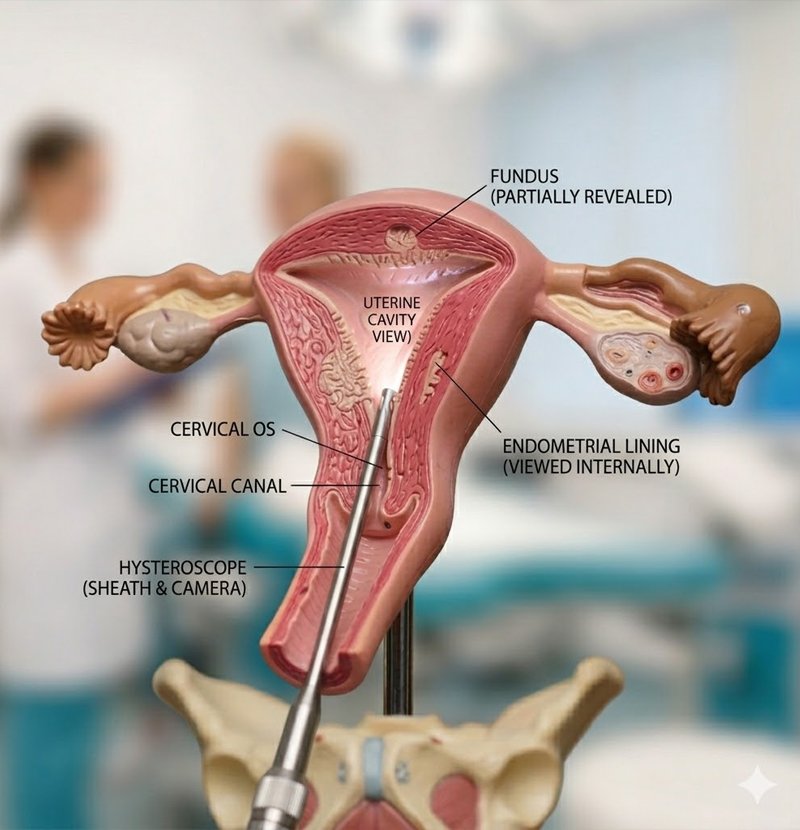
Hysteroscopy uses a thin telescope inserted through the natural passage, meaning no external cuts or stitches.
Preparation
Done typically after your period (Day 6-10). No prolonged fasting is usually required for diagnostic procedures.
Insertion
A thin hysteroscope (telescope) is gently passed through the cervix. Saline water expands the uterus for a clear view.
Treatment
Using tiny instruments through the scope, we can remove polyps, fibroids, or correct septums instantly.
Why is it Done?
Abnormal Bleeding
Investigating the root cause of heavy, prolonged, or irregular periods. Hysteroscopy allows direct visualization to identify polyps, submucosal fibroids, or endometrial hyperplasia that ultrasounds might miss, often allowing for immediate biopsy or treatment.
Polyp Removal (Polypectomy)
uterine polyps are common causes of spotting and infertility. Dr. Khemani uses precision hysteroscopic techniques to remove these growths completely from the root without damaging the surrounding healthy uterine lining, ensuring immediate symptom relief.
Submucosal Fibroid Resection
Removing fibroids that bulge into the uterine cavity (submucosal) and cause severe bleeding or fertility issues. Using a resectoscope, these can often be shaved down completely through the cervix, avoiding the need for open surgery or cuts on the abdomen.
Infertility Evaluation
A critical step before IVF or IUI. We assess the uterine cavity for any anatomical barriers to implantation, such as adhesions, scar tissue, or congenital anomalies, ensuring the 'soil' is perfect for the embryo.
Septum Correction (Metroplasty)
Correcting a septate uterus (a congenital partition inside the womb) is vital for women with a history of recurrent miscarriage. Hysteroscopic resection restores the normal cavity shape, significantly improving the chances of carrying a pregnancy to term.
Lost IUCD Retrieval
Locating and safely removing an Intrauterine Contraceptive Device (Copper-T) when its strings are no longer visible. Hysteroscopy avoids blind manipulation and ensures the device is removed without injury to the uterine walls.
Diagnostic vs. Operative
Hysteroscopy: What to Expect
Hysteroscopy is one of the most valuable tools in modern gynecology, allowing direct visualization of the uterine cavity. Unlike ultrasound or MRI, which provide indirect images, hysteroscopy gives the surgeon a real-time, magnified view of the uterine lining — making diagnosis incredibly accurate.
Diagnostic hysteroscopy is a quick, often outpatient procedure used to investigate abnormal bleeding, recurrent miscarriages, or infertility. A thin telescope (2-5mm) is inserted through the cervix — no incisions are needed. Most women describe mild cramping, similar to a period.
Operative hysteroscopy goes a step further — the surgeon can remove polyps, fibroids (myomectomy), adhesions (synechiae), or correct uterine septum in the same sitting. This "see and treat" approach eliminates the need for a second procedure, saving the patient time, cost, and anxiety.
Dr. Vinita Khemani performs hysteroscopy at well-equipped hospital settings, ensuring patient safety with anesthesia support and advanced resectoscope technology. For many women struggling with unexplained infertility or recurrent pregnancy loss, a single hysteroscopy can identify and correct the problem.
Need a Uterine Evaluation?
Hysteroscopy provides the most accurate diagnosis for abnormal bleeding, polyps, fibroids, and infertility-related uterine issues.
Expert Hysteroscopy Care
For Uterine Preservation
With 23+ years of surgical excellence, Dr. Khemani uses advanced "See & Treat" hysteroscope technology to ensure safe, scarless, and effective outcomes for every patient.
Advanced German Optics
Utilizing high-definition Storz/Wolf hysteroscopes for crystal-clear visualization, permitting Dr. Khemani to identify even the smallest pathologies that standard ultrasounds often miss.
Single-Sitting "See & Treat"
A unique approach where diagnosis and treatment happen simultaneously. If a polyp or fibroid is found, it is removed immediately, sparing you a second surgery.
"Accurate diagnosis is the first step to a cure. Hysteroscopy allows us to see the problem directly and fix it instantly."
23+
Years Experience
10k+
Procedures Done
Day Care
No Overnight Stay
Painless
Minimal Recovery
Fertility Optimization
Special focus on restoring the uterine cavity's shape and lining health to maximize implantation success rates for natural conception or IVF cycles.
Painless Day Care
Performed under safe short sedation in top hospital settings. Patients typically walk and walk out the same day with minimal to no downtime.
Common
Questions
Everything you need to know about Hysteroscopy.
Dr. Vinita Khemani is a highly experienced gynecologist known for her skill in diagnostic and operative hysteroscopy. She successfully treats uterine polyps, fibroids, and septums with minimal intervention.
The cost depends on whether it is diagnostic or operative and the hospital chosen. Dr. Khemani strives to provide affordable, transparent pricing packages for hysteroscopy at leading the city hospitals.
Diagnostic hysteroscopy is often painless or causes only mild cramping, similar to a period. Does not always require anesthesia. Operative hysteroscopy (removing polyps/fibroids) is done under mild sedation or short anesthesia at our the city facilities so you sleep through it.
A diagnostic look takes only 5-10 minutes. If a procedure is needed (like polyp removal), it may take 20-30 minutes.
No. Hysteroscopy is almost always a Day Care procedure. You come in the morning to the hospital and go home by afternoon.
Ideally, just after your period finishes (Day 6-10 of your cycle). This is when the lining is thinnest and the view is clearest.